Nexus Link — Official Verified Onion Access 2026
http://nexusaldu7wwewcpcn4reptcp72rsaeogolfvjncafua2oywwswwyaqd.onion
This is the current verified Nexus link. Status reads online or checking from a live probe — never a hard-coded label. Tap Copy, then open in Tor Browser at the Safest level. See all verified Nexus mirrors →
The verified Nexus link sits on this page right now, in the box above. Copy it, paste it into Tor Browser, and you reach the real marketplace in one move. No detours. The Nexus link shown here is cross-checked against the PGP-signed mirror announcement before it ever loads on your screen.
Verified Nexus Link (Instant Access)
That single check is what separates a genuine official Nexus link from the phishing clones crowding search results in 2026. Verify first. Then connect. Below the onion box you will find every reason this source earns your trust, the live mirror list, the Nexus security model, and a short guide to safe access.
Official Nexus Link & How to Verify It
An official Nexus link is the onion address the marketplace operators publish and sign with their own PGP key. Anyone can register a lookalike address. Only the real team can produce a signature that matches the public key Nexus pins for the community. That is the whole game. The address by itself proves nothing; the signature over the address proves everything.
Why does this matter so much in 2026? Search results, forum posts, and paste sites fill up with addresses that differ from the genuine Nexus link by a few characters. A clone copies the login page pixel for pixel, captures your username and password, then forwards you to the real site so you never notice the swap. The defense is not "look carefully." The defense is cryptographic. Match the signature, or do not connect.
Confirm the Nexus link in four steps
- Copy the PGP-signed mirror list published by the Nexus team.
- Import the marketplace public key into GnuPG or Kleopatra.
- Run a signature check against the signed message.
- Confirm the onion address inside the verified message matches the address in our onion box, character for character.
If the signature is good and the addresses match, you hold the official Nexus link. If the signature fails, stop. We re-run this check ourselves each time the marketplace rotates an address, which is why the Nexus link here stays current rather than going stale the way static lists do. A verified Nexus link is the only link worth using, and the check takes under two minutes once your key is imported.
One more habit worth building. Bookmark the verified source, not the raw onion address. Addresses rotate; a trusted source that keeps publishing signed updates does not. That is the quiet logic behind this page, and it is why a single Nexus link bookmark here beats a folder full of addresses you copied from a forum last month.
About Nexus Market
Nexus launched on 22 November 2023 and climbed fast. It now holds a top-2 position among darknet marketplaces, a rank earned through feature depth and a steady security record rather than noise. The growth curve is plain to read: 500 users at launch in November 2023, 10,000 by Q1 2024, top-5 status by Q3 2024, and the top-2 spot by Q4 2024. Through Q1 2026 the platform sustained a base above 50,000 registered members. Around 2,500 vendors operate across it, with 1,800+ active at any time and 85% holding verified status.
Registered users
A base above 50,000 members sustained through Q1 2026.
Vendors
1,800+ active at any time, 85% holding verified status.
Avg vendor rating
Day-to-day experience, not a slogan — backed by reviews.
What does Nexus actually offer? A multi-category marketplace wrapped in a cyberpunk-styled interface, built mobile-first from the ground up — a genuine point of difference in a field where most sites still assume a desktop. The mobile build is fully responsive, the dark theme is tuned for Tor Browser, and the platform ships in 15+ languages. Lightning-fast search and deep filters help buyers find listings quickly, and a vendor reputation system keeps quality visible. The average vendor rating sits at 4.7 out of 5, a number that says more about day-to-day experience than any slogan could.
The marketplace built its standing on reliability. Uptime runs near 99.5%, and the infrastructure leans on RAM-only databases, automatic failover, and multi-level DDoS protection to stay reachable when mirrors come under load. That resilience is the practical reason a Nexus link can rotate and the marketplace stays online behind it. Stability is the foundation a verified Nexus link points toward.
Two features set Nexus apart from older markets, and both reflect a build-it-better mindset. The first is DAO governance: community members propose features, vote on marketplace policy, and shape the roadmap directly, so the platform answers to the people who use it rather than to operators alone. The second is AI-powered customer support, which handles routine questions instantly and frees human staff for the cases that genuinely need them. Add an integrated forum, personalized recommendations, wishlists, and order tracking, and the shape of a modern marketplace comes into view. That is the platform the official Nexus link connects you to.
Where does the platform sit against the wider field? It launched later than most of the names buyers recognize, yet it reached the top tier inside two years — a pace that says the build resonated. Against an older market, the trade is a shorter track record for a more modern feature set: mobile-first design, DAO governance, AI support, and a payment layer spanning three currencies rather than one or two. Against a newer entrant, the trade runs the other way — the platform already carries the scale, the verified-vendor base, and the uptime record that a fresh site has to earn. The pattern is consistent: rarely the most extreme on any single axis, consistently among the most complete.
Why Use the Verified Nexus Link
Trust here is not a feeling. It is a set of mechanisms you can check. The verified Nexus link matters because it sits on top of mechanisms that hold up under scrutiny, and because using any other Nexus link puts those mechanisms out of reach. The link is the gate; the mechanisms are what the gate protects.
Start with the escrow design. Nexus runs a multi-signature escrow that needs more than one key to release funds, so no single party — vendor or operator — can move your money alone. Pair that with end-to-end encrypted messaging and a dispute-resolution process, and the structure that fails on weaker markets simply has no room to fail here. Funds sit in the multi-sig account until the order completes or a dispute settles. That is the design, and it only applies on the real platform.
Then there is the track record you can quantify. The average vendor rating across Nexus is 4.7 out of 5, and 85% of the 2,500+ vendors carry verified status — meaning they passed PGP key verification, identity confirmation, and a transaction-history review before earning the badge. Customer satisfaction sits at 4.6 out of 5, and the return rate of roughly 75% says buyers come back rather than try once and leave. Numbers like these are the kind a phishing clone can print in text but never deliver in practice.
Why route through the verified link specifically? Because the protections above only exist on the genuine site. A clone can show you a fake escrow address, a fake dispute button, a fake balance — and your money goes nowhere good. The verified link is the gate to the real multi-sig escrow, the actual dispute process, and the genuine reputation system. A copied link that skips the gate skips every protection it guards. Only the genuine link surfaces the real numbers. Trust the mechanism, and use the link that reaches it.
Security & Privacy on Nexus
The Nexus security model runs deep for the space, and a short tour of it is worth your time before you connect. Learn the model. Then trust the model.
PGP everywhere
PGP encryption is mandatory for sensitive communication on Nexus, end-to-end between you and the vendor. The marketplace signs its official announcements with PGP so you can verify them yourself — which is precisely how you confirm a Nexus link is genuine. Use 4096-bit keys.
Two-factor authentication
2FA stacks on top of your password so a stolen password alone gets no one in. Turn it on the moment you register. A TOTP code from any authenticator app closes the most common account-takeover path on its own.
Multi-signature escrow
Every transaction moves through a multi-sig escrow that requires more than one key to release funds. Neither the vendor nor the platform can take the money unilaterally — the structural protection custodial markets lack.
RAM-only, resilient infrastructure
Nexus servers run on RAM-only databases, so very little is written to disk. Automatic failover keeps the marketplace reachable under load, multi-level DDoS protection absorbs attacks, and regular pentests keep the posture honest.
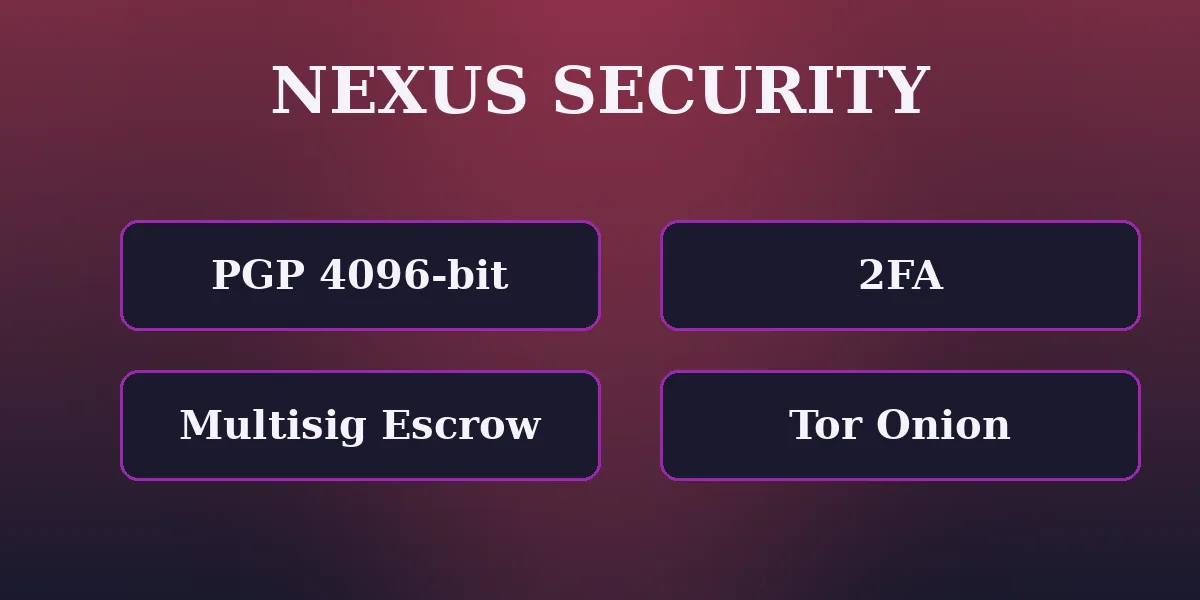
How do these pieces protect you in practice? Picture a single order. Your password gets you to the login; your 2FA code stops anyone who somehow learned that password; PGP keeps your messages to the vendor unreadable to anyone but the two of you; the multi-sig escrow holds your funds where neither the vendor nor the platform can take them alone; the RAM-only servers mean your order leaves little forensic trail to begin with. Each layer covers a different threat. Remove any one and a gap opens. The Nexus design stacks them — defense in depth, applied to a marketplace. The verified Nexus link is your entry point to all of it.
How to Access Nexus Safely
Safe access comes down to a short routine, in order. Do these eight things the same way every time and the routine protects you.
- Install Tor Browser from the official Tor Project site only — never a mirror, never a "modified" build.
- Set the security level to Safest. Open the shield menu and choose Safest. This disables JavaScript site-wide, one of the strongest defenses against deanonymization.
- Leave the window at its default size and add no extensions, so your browser fingerprint matches everyone else's instead of standing out.
- Import the Nexus PGP key if you have not already, and confirm its fingerprint against the one the marketplace publishes.
- Copy the verified Nexus link from the onion box on this page.
- Verify the PGP signature over the mirror announcement; a good signature is your proof the link is genuine, and the address must match character for character.
- Paste and connect through Tor — never through a clearnet gateway.
- Log in with credentials that exist nowhere else: a unique username and a unique password, never reused, never tied to any clearnet identity.
Nexus is mobile-first, and the onion box on this page copies cleanly on a narrow screen, so you can reach the marketplace from a phone. For safety, though, the stronger setup runs Tor inside Tails or Whonix on a desktop rather than on your everyday phone or laptop. Tails forgets everything at shutdown; Whonix forces all traffic through Tor at the network layer. The full walkthrough lives on our how to access Nexus safely guide.
Nexus Payments — Bitcoin, Monero & Litecoin
Payment privacy is a spectrum, and Nexus lets you pick where you sit on it. Three currencies, three different profiles, one integrated wallet that handles conversion for you.
Bitcoin (BTC) is the primary currency on Nexus and the one most buyers arrive holding. Its blockchain is public by design, so privacy here comes from how you handle it — fresh receiving details, careful timing, and the integrated wallet's conversion tools all add distance between you and your funds. Bitcoin is the path of least friction: widely held, widely understood, accepted everywhere on the platform.
Monero (XMR) is the privacy choice. Three mechanisms work together under the hood. Ring signatures mix your transaction with others so the true sender is obscured. Stealth addresses generate a fresh one-time destination for every payment, hiding the receiver. Confidential transactions conceal the amount sent. The result is that an XMR payment reveals almost nothing on its own ledger — sender, receiver, and amount are all shielded by the protocol itself. If privacy is your priority, XMR is the clear pick.
Litecoin (LTC) is the speed option, built for fast, low-cost confirmations when you want a payment to settle quickly. The integrated Nexus wallet ties all three together with automatic currency conversion and real-time exchange rates, so you can fund an order in whichever currency you hold and let the platform handle the rest. Practical takeaway: pay in XMR for privacy, BTC for ubiquity, LTC for speed — and start from the verified Nexus link either way.
Live Nexus Crypto Prices
The widget above pulls BTC, XMR, and LTC prices live and refreshes every 60 seconds, so the numbers you see are current rather than baked in. Why does this belong on a Nexus link page? Because crypto moves, and escrow takes time. Funds locked in escrow sit exposed to price swings for the duration. Checking the live rate before you fund an order — and knowing roughly where it stands when funds release — is simply good practice. The price feed also keeps this Nexus link page genuinely fresh, which helps the verified link stay visible in search rather than going stale.
Nexus Link Verification Checklist
Run this checklist every time before you connect. Nine quick checks, and a real Nexus link passes all nine:
- The onion address matches the PGP-signed mirror list, character for character.
- The PGP signature over that mirror list verifies cleanly against the Nexus public key.
- The marketplace public key matches the fingerprint Nexus publishes for the community.
- You typed or pasted the address yourself; you did not click a link from a forum DM or an email.
- Tor Browser is set to the Safest security level before you load anything.
- The address ends in
.onionand you reached it only through Tor, never a clearnet gateway. - Your login credentials are unique to Nexus and reused nowhere else.
- 2FA is enabled on your account before you transact.
- Nothing on the page asks for real-world PII, a personal email, or payment outside the platform's own escrow.
Pass all nine and you are on the genuine site. Fail any one and you stop. This is the difference between a verified Nexus link and a costly mistake — and it costs you two minutes. Save this verified link, and re-check it each visit, because a link that passed last week can be replaced by a clone this week.
Nexus Community & DAO Governance
Most marketplaces run top-down. Nexus runs a DAO instead — a governance model where the community holds real say. Members propose features, vote on marketplace policy, weigh in on the roadmap, and even take part in community arbitration of disputes. The practical effect is that the people using the platform shape where it goes, which keeps incentives aligned in a way a closed operator team rarely manages.
The integrated forum is where that governance lives day to day. It carries marketplace discussion, vendor announcements, security advisories, and peer support, so news reaches users directly rather than through third-party channels. AI-powered support sits alongside it, answering routine questions instantly and routing the harder cases to human staff. The forum is also where the official link gets announced and re-signed after each rotation, so the same place you go for community news is the place a fresh signed link appears — one more reason the verified link beats a static address copied from elsewhere.
Nexus Security & Privacy Resources
Before you open any Nexus link, get the fundamentals right. These are the official, independent tools the privacy community trusts — for anonymity, encryption, wallets, and verification. Bookmark them, then come back to the verified onion box above.
Nexus Link — Frequently Asked Questions
Right here, in the onion box at the top of this page. It is the current verified Nexus link, cross-checked against the marketplace's PGP-signed mirror list. Bookmark this verified source rather than the raw address, because the link rotates while a trusted source keeps publishing signed updates. One bookmark, always current. For the full set of current addresses, see the live Nexus mirrors list.
Match the cryptographic signature, not the look of the page. Import the Nexus public key into GnuPG, verify its signature over the published mirror list, and confirm the onion address matches what you see here, character for character. A clone can copy the login page perfectly but cannot forge that signature. Signature good plus address match equals a genuine Nexus link.
Yes — Nexus is mobile-first, and the link box on this page copies cleanly on a narrow screen, so tapping the verified link on a phone works. For stronger safety, open that same link with Tor inside Tails or Whonix on a desktop instead, since a mobile browser leaves more gaps. The link is identical either way; mobile gets you in, desktop with Tails keeps you safer.
Pick by priority. Monero offers the strongest privacy through ring signatures, stealth addresses, and confidential transactions that shield sender, receiver, and amount. Bitcoin is the primary currency and the most widely held, with privacy depending on careful handling. Litecoin settles fastest. For privacy-minded buyers, XMR is the better choice; the integrated Nexus wallet converts between all three automatically.
Mirror addresses rotate on purpose to stay resilient against DDoS attacks and to make tracking harder, with automatic failover moving traffic to a healthy mirror when one drops. That is exactly why a verified, frequently updated source beats any static Nexus link you find elsewhere.
Access Nexus Now
The verified Nexus link is in the onion box above — copy it, open Tor Browser at the Safest level, and connect. That is the whole path. For the full set of current mirrors with live status, head to the live mirror list. New to safe access? Start with the safe-access guide and come back once you are set up. Verify the signature, use a unique login, enable 2FA, and pay in XMR if privacy is your priority.